
By Rabbi Tara Feldman
Friends of Siach Shalom Cofounder
It has been a significant year for Meir and for me as we launched our Gen Z Learning Journey program engaging Jewish 18 to 24 year olds from North America, Israel and Europe. Zionism was our binding theme—the founding ideals of Zionism and critiques against Zionism creating the curricular framework. Sessions were enriched by guest speakers, along with preparatory readings and videos. Each group consisted of about 15 Gen Zers who met on Zoom six times for an hour and a half. Some participants considered themselves strong Zionists; a few identified as anti-Zionist. Most found themselves in a place of connection to Israel but with unanswered questions, fears and concerns.
Distilled to its essence, our “takeaway”—from our Gen Z experiences thus far—is this: More important and impactful than any of the information we might impart is the creation of relationships among participants. Sharing personal stories (and creating a space to ask questions in response) combined with ample time in breakout rooms and hevrutot (dialogue partnerships) between meetings enabled an intimate, global Jewish conversation. Thoughtful Jewish Gen Zers all over the world are seeking spaces which are neither echo chambers nor shouting matches. We feel inspired to have begun to create such a forum which is deeply aligned with the Israel-based work of Siach Shalom. In recent months, we met with potential new partners—among them, synagogue educators and Hillel professionals in the U.S. and Israel to share our curriculum and dialogue model. We also recruited for and launched two groups which were scheduled to meet in June, July and August.
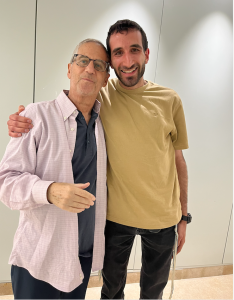
A Gen Z cohort participant visits Meir in the hospital.
Unfortunately, for us Feldmans, life has taken an unexpected turn. This summer, just as we were beginning our fourth Gen Z group, Meir had emergency open heart surgery followed by a stroke. Thus, for the time being as we focus on Meir’s healing, we have put our Siach Shalom Gen Z work on hold. In spite of the challenges we now face, it is a blessing to be in Israel where the resources for stroke recovery are phenomenal. Meir is still hospitalized at a rehabilitation facility and is making incredible strides. His resilience, ability to connect with others, humor and profound optimism are core elements of our journey.
In support of Meir’s growing ability to express himself, his occupational therapist recently asked him to say a few words on the meaning of teshuvah (return, repentance). As Meir has only recently begun to speak, I recorded them in wonder. I share his thoughts with you below as something of a miracle, a sign of how far we have traveled thus far. I offer his words, also, as prayer for the new year, an acknowledgment of all that is still possible, even in the face of a future that is, as yet, unknown.
May the year 5786 be a year of health and healing, of courage and connection, strength and renewal for us all.
What Is the Meaning of Teshuvah?
“It is the point of touching base, touching the heart of something…an honest place, a place that is potentially important. It helps us enter into these ultimate moments, to feel the power of sustained blessing.”
—Rabbi Meir Feldman